


 Aeronautics
ALTEN and the Sustainable Development Goals: a commitment to the UN Global Compact since 2010
ALTEN has been a signatory of the United Nations Global Compact since 2010, the world’s leading corporate sustainability initiative. The Group explains how this commitment plays out across its four strategic CSR pillars, through precise targets from the UN’s Sustainable Development Goals (SDGs).
What are the Sustainable Development Goals (SDGs)?
Adopted in 2015 by the UN’s 193 member states, the 17 Sustainable Development Goals (SDGs) set 169 targets to be reached by 2030, organized around five broad themes: people, prosperity, planet, peace and partnership. These goals are not legally binding on states — and from the start, the UN envisioned a role for other actors in society, including businesses, in helping to achieve them.
The private sector’s contribution rests on three drivers: regulation (the EU’s CSRD directive now requires large companies to report in detail on their environmental, social and governance impacts, using frameworks that overlap significantly with SDG themes), financial markets (extra-financial rating agencies now factor SDG alignment into their assessment criteria), and stakeholder expectations (employees, clients, shareholders), who increasingly expect documented commitments rather than general communication.
What is the UN Global Compact?
The United Nations Global Compact invites business leaders to publicly commit, to the UN Secretary-General, to uphold ten principles covering human rights, labour standards, the environment and anti-corruption. Since 2015, this commitment has also incorporated the 17 SDGs of the 2030 Agenda. It is today the world’s most widely adopted corporate sustainability initiative.
Why ALTEN is committed to the SDGs?
As a global player in engineering and IT services, ALTEN operates in a sector where attracting and retaining talent, meeting the growing sustainability expectations of clients and investors, and anticipating regulatory change have become competitive issues. Joining the Global Compact in 2010 reflects that logic: building a CSR approach that fits the Group’s business, rather than reacting to external pressure. ALTEN renews its commitment to the ten principles of the Global Compact every year.
This approach is now recognized by independent extra-financial rating agencies: ALTEN was awarded a B rating from CDP Climate Change in 2025, up from its first Ethifinance assessment in 2012.
The Group’s Sustainable Development Charter is structured around nine commitments, grouped into four strategic pillars. Each of these pillars is linked to specific SDGs and targets, summarized in the table below.
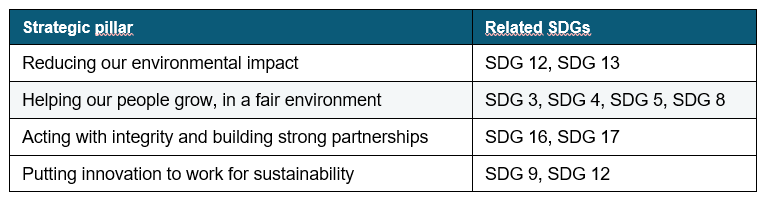
Pillar 1: Reducing our environmental impact (SDG 12 and 13)
This pillar covers reducing the Group’s environmental footprint and supporting clients in moving toward more sustainable solutions. It addresses two UN goals: more responsible consumption and production (SDG 12), and climate action (SDG 13).
In practice, this means raising employee awareness of good environmental practices, and running a procurement policy that favours suppliers committed to sustainability — supporting the less advanced ones to improve, rather than excluding them.
On climate, ALTEN finalized its transition plan in 2025, with a trajectory validated by the Science Based Targets initiative (SBTi) — an international body that verifies whether companies’ climate targets are aligned with the Paris Agreement. The Group is acting on four levers: business travel, buildings, procurement and digital usage, with a target of net-zero emissions by 2050. Between 2019 and 2024, its greenhouse gas emissions already fell by around 28%, with a new target of over 60% reduction by 2030 (versus 2019).
Pillar 2: Helping our people grow, in a fair environment (SDG 3, 4, 5 and 8)
This pillar covers working conditions, training and equal opportunity across the Group. It links ALTEN’s HR activity to four UN goals: health (SDG 3), education (SDG 4), gender equality (SDG 5) and decent work (SDG 8).
On health, ALTEN runs occupational risk-prevention actions as well as programs supporting employees’ physical and mental health.
On education and skills development, the Group relies on partnerships with engineering schools and universities, and on programs that encourage young women to pursue scientific and technical fields. Internally, the “Boost ta Carrière” mentoring program, rolled out in France since 2023, has brought in more than 250 employees a year and generated over 100 promotions.
On gender equality, ALTEN signed the Women’s Empowerment Principles in March 2024, an initiative led by UN Women and the Global Compact that commits companies to making progress on this issue. The engineering sector remains male-dominated: the Group is made up of 89% engineers, of whom 27% are women internationally, and women make up around 30% of the Group’s overall workforce in 2025. A dedicated action plan to increase female representation is planned for 2026.
Finally, on working conditions, ALTEN highlights competitive salaries and ongoing investment in training and R&D to develop employees’ skills.
Pillar 3: Acting with integrity and building strong partnerships (SDG 16 and 17)
This pillar covers governance, business ethics and partnerships, addressing two UN goals: transparent institutions (SDG 16) and partnerships for collective action (SDG 17).
On anti-corruption, ALTEN applies governance rules set out in a Code of Conduct and checked through regular audits, supported by a network of ethics and compliance ambassadors present in every Group entity.
On partnerships, ALTEN supports more than 150 associations and NGOs through donations, skills-based volunteering and IT projects — for example “Le Royaume d’Ailm,” an educational video game developed with the association Burns and Smiles to help severely burned children better understand their care journey.
These commitments draw on international frameworks: the ten principles of the Global Compact, the Universal Declaration of Human Rights, the fundamental conventions of the International Labour Organization, and the OECD Guidelines for Multinational Enterprises.
Pillar 4: Putting innovation to work for sustainability (SDG 9 and 12)
Every year, ALTEN dedicates part of its resources to research and development through the ALTEN Labs’ “Smart Digital” program: nine research programs that harness data and artificial intelligence on topics such as eco-design, industrial digital twins and low-carbon logistics. The Group tracks a “sustainable innovation rate” indicator, measuring the share of its R&D projects with a positive environmental or social impact: it stood at 36% in 2025.
This work contributes to two UN goals: innovation in support of more sustainable industry (SDG 9) and more responsible consumption (SDG 12). A digital twin tool, developed since 2021, allows client companies, for example, to analyze and optimize their supply chains against sustainability and risk-management criteria.
A qualitative assessment, not a product-by-product measurement
ALTEN is clear about the scope of this mapping: aligning its activities with the SDGs relies on a qualitative analysis, drawing on internal expertise and dialogue with stakeholders, rather than an exhaustive, product-by-product quantitative assessment. The aim is to guide priorities by sector, client and geography, taking into account the diversity of the local contexts in which the Group operates.
In summary
ALTEN’s CSR approach links its activities to seven of the seventeen SDGs in the 2030 Agenda: SDGs 3, 4, 5, 8, 9, 12, 13, 16 and 17. Each goal is tied to concrete actions, tracked in the Group’s Universal Registration Document and included in its annual Communication on Progress to the UN Global Compact.